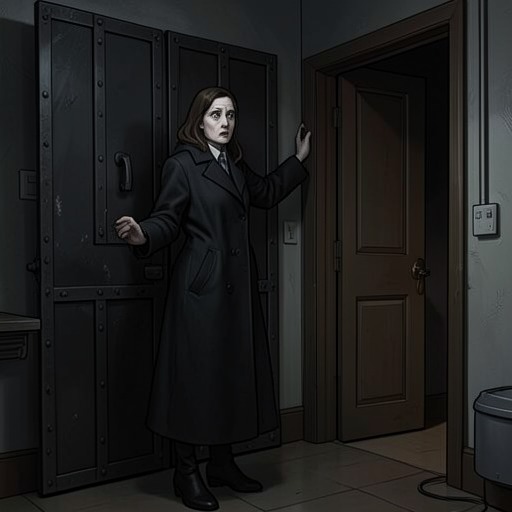
Miss Russell
The Murder of Roger AckroydMiss Russell, the formidable housekeeper at Fernly Park, is both a subject of village speculation and a witness whose recollections matter to the murder inquiry. Her five-year tenure, pointed remarks about dependence on charity, inquiry into drug addiction, and account of the open silver table place her at the intersection of household hierarchy, concealed vulnerability, and the investigation’s physical clues.
Position at Fernly Park
For at least fifteen years, the village had expected Roger Ackroyd to marry one of the successive housekeepers who presided over his home. Miss Russell, the last of them, had held the position for five years—twice as long as any predecessor—and was regarded as firmly established there. The arrival of Mrs. Cecil Ackroyd and her daughter at Fernly Park changed that household balance: village gossip held that Mrs. Cecil Ackroyd had put Miss Russell in her proper place.
That phrase carried a social sting. Miss Russell was described as going about with pinched lips and an acid smile, while professing sympathy for Mrs. Cecil Ackroyd as a woman dependent on her brother-in-law’s charity. Her pointed observation that she herself would be miserable if she did not work for a living sets her own employment against Mrs. Cecil Ackroyd’s dependence. The remark reveals the class and financial tensions surrounding the house, as well as the sharpness with which Miss Russell comments on them.
Question About Drug Addiction
In conversation with Dr. James Sheppard, Miss Russell asked whether a person enslaved by drug use could be cured. She then raised veronal as a specific example. Dr. James Sheppard answered with a short explanation, while privately suspecting that she was seeking information about Mrs. Ferrars.
The question links Miss Russell to the story’s concern with drug use and the circumstances surrounding Mrs. Ferrars, but the evidence does not confirm whom she had in mind or why she asked. Its importance lies in the contrast between the plainness of the medical question and the uncertainty surrounding its purpose: Miss Russell seeks information, while Dr. James Sheppard interprets that request through his suspicion about another person.
Account of the Silver Table
During the investigation at Fernly Park, Miss Russell told the inspector that she did not think she had gone near the silver table. She explained that she had been checking whether the flowers were fresh, then recalled that the table was open when she passed it. Because it should have been closed, she said she shut the lid as she went by.
Her account gives the inquiry a specific piece of household chronology: the silver table was open, and Miss Russell says she closed it. When asked whether the dagger had been in its place at that time, she looked at the inspector aggressively; the supplied passage ends before her answer. The detail therefore establishes what she recalls doing but leaves unresolved what she saw, and whether the dagger was present.
Narrative Role and Limits
Miss Russell’s characterization is built through friction between position and vulnerability. She is a long-established servant whose standing in the household is unsettled by Mrs. Cecil Ackroyd’s arrival, yet she speaks with confidence about charity and paid work. Her questions and testimony make her relevant to the investigation without, in the available evidence, resolving either her motive or her knowledge of the murder.
The information about her is filtered through village gossip and Dr. James Sheppard’s suspicions. The narrative thus presents her partly as she appears to others—sharp-tongued, watchful, and forceful—and partly through questions that remain open. Her account of the table is concrete, but the passage’s unanswered question about the dagger preserves uncertainty rather than supplying a verdict.